In the smoky glow of 1930s America, when neon signs buzzed above diners and jazz bands spilled out of dance halls, a strange machine began humming in the corner of bars and cafés. It wasn’t alive, yet it had a voice. For a coin, it would sing back to you, offering not just music but a moment of control in a world slipping through the fingers of the Great Depression. This was the jukebox the people’s orchestra, the electric shrine of sound.
The Promise of a Nickel Dream
The jukebox didn’t start as the glamorous chrome-and-glass spectacle we remember. Its roots trace back to 1889, when Louis Glass and William Arnold unveiled the Nickel-in-the-Slot Phonograph in San Francisco. Crude and boxy, it offered scratchy tunes through listening tubes, more curiosity than cultural revolution. Yet buried in its clunky mechanics was a radical idea: that ordinary people could choose their music, instantly, without waiting for a band or buying a ticket.
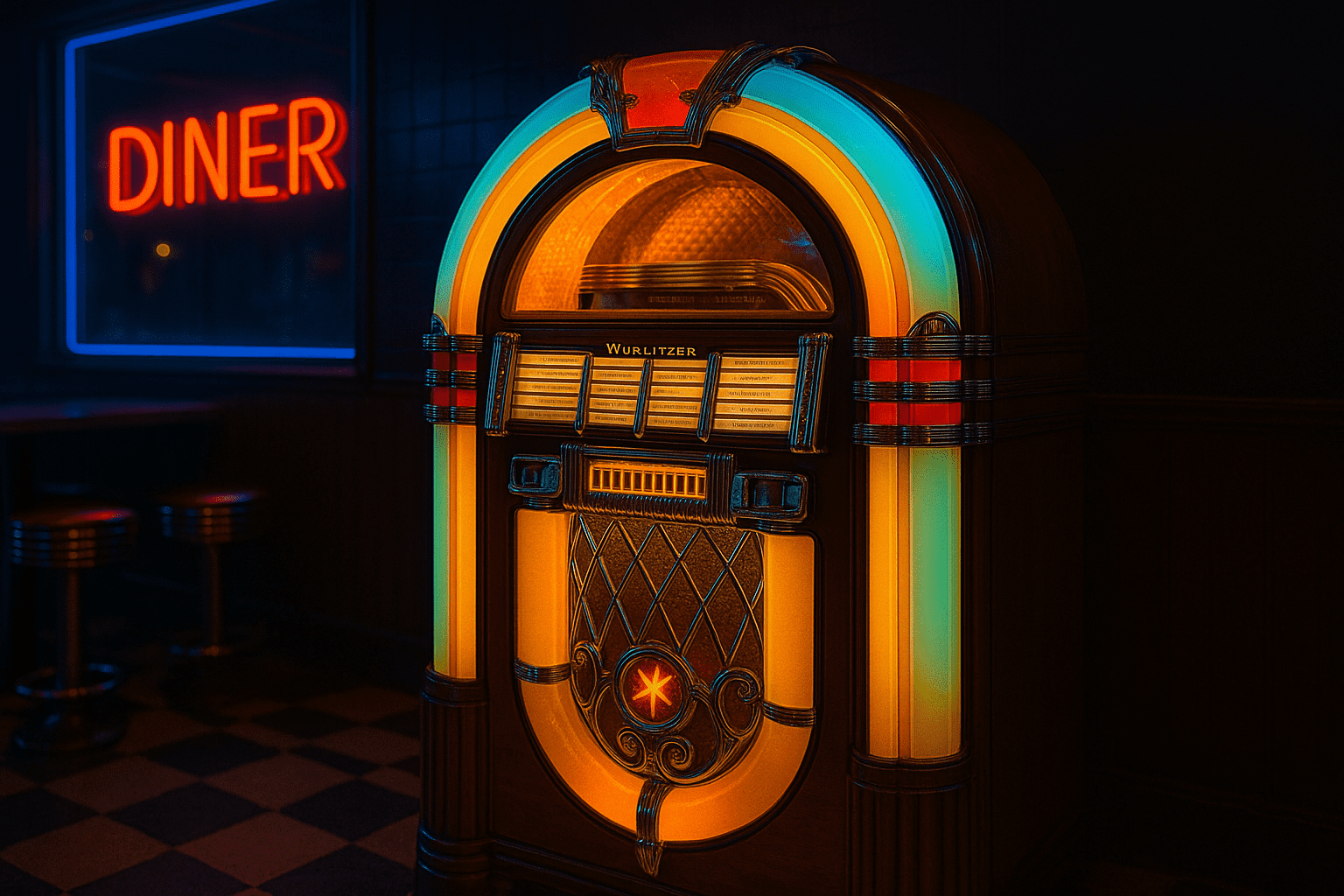
By the 1930s, technology had caught up to the dream. Amplifiers roared to life, records improved in clarity, and the jukebox transformed into a glowing temple of chrome, wood, and glass. Drop a coin, push a button, and the machine obeyed. In an era of uncertainty, when jobs vanished and hope was rationed, the jukebox gave people something priceless a sense of agency wrapped in rhythm.
The Push and the Backlash
The jukebox was loved by the people but loathed by moral guardians. Preachers warned it was a “mechanical corrupter,” spreading jazz and blues the so-called “devil’s music” into small towns. Politicians tried to regulate it, painting it as a tool of vice lurking in pool halls and back rooms. Even musicians, fearing for their livelihoods, accused it of stealing their work. But resistance couldn’t silence the machine.
Because while censors wagged their fingers, couples leaned against jukeboxes with their first nervous touch. Soldiers on leave fed nickels to hear songs that tethered them to home. Teenagers in the 1950s claimed them as rallying points, blasting Elvis and Little Richard into the night. The jukebox became less a machine and more a confessional, a stage, a time machine that could carry you anywhere for five minutes and a nickel.
Legacy in Chrome and Memory
The golden age of the jukebox peaked in the mid-20th century. Wurlitzer, Seeburg, and Rock-Ola crafted machines that looked like futuristic altars, alive with glowing plastics and gleaming chrome. They stood not just as entertainment devices but as monuments to the democratization of music. Anyone, no matter their station, could summon Sinatra or Ray Charles, Patsy Cline or Buddy Holly, with the press of a button.
Though their dominance faded with the rise of portable radios, cassette tapes, and eventually digital playlists, jukeboxes never truly died. Today, they sit as nostalgic relics in retro diners, collectors’ living rooms, and museums symbols of an era when music leapt from steel and vinyl, demanding to be heard.
The jukebox was more than invention. It was defiance. It was hope squeezed into a coin slot. And for generations of listeners, it was proof that even in the hardest of times, music could still belong to the people.